Moto Intel Report – June 24, 2020

I fully admit it. I’m the kind of guy who likes switching motorcycles a lot. In the 12 years I’ve had my motorcycle license I have owned 6 motorcycles. To me, that’s a lot. Although to others it might not be 🙂
In chronological order I have owned:

Overall I’ve been happy with all of these bikes. They all have something special or are good at some specific thing. But, if I had to choose now, I’d take my old trusty 1999 Yamaha hands down! It was my first bike and even though it’s in the autumn of its life now, it has yet to let me down.
It’s not only the emotion and reliability though. I like the simplicity and efficiency of it. No riding modes, no digital dashboard, a good old carburator and not even a fuel gauge let alone gear indicator. This is pure riding without distractions. And should it break down, then every mechanic on a random street corner will be able to fix it.
It’s not the most powerful of all bikes I owned, in fact it’s the least powerful of all, but it brings a smile on my face every time I ride it, and it has plenty of grunt to keep up with my friends in the twisties.
Another advantage of such an old bike is that you can be a bit more careless. It’s not a big deal if you drop it or scratch it. So I’ve taken it offroad on trails, where even my friends on their KTM’s had a rough time. Sure, it’s hard work, but it can handle just about anything.
So why do I even own other motorcycles besides this one? Well… that’s a good question 🙂. I guess it goes back to the title of this article. It’s heart winning from mind, emotion trumping logic and function loosing to looks.
Even though logically this is the only bike I need, it’s not a head turner and it’s not as smooth as a new bike. Also, because it’s been financially written off (I wouldn’t get much for it if I would sell it now anyway), I can afford to keep this around as a ‘spare’ bike while my main ride is something newer. I still use it for the occasional ride around the block and for when I have motorcycle buddies visiting from overseas. (You see what I’m doing here? I’m bending logic so it fits with my heart 😃)
I’ve had my new Yamaha, the FJ09 Tracer, for about a year now, which means, going by my average, I’m due for a new bike next year.
As I’m a bit of a nerd and like looking, comparing and scouring the internet for reviews (mostly I know everything about a motorcycle before I even set foot in the dealer showroom), I’ve already narrowed down my choices. And again it’s a typical choice between Heart and Mind, Emotion and Logic and Looks and Function.
Here are the two bikes I’m thinking about at the moment:
Before I get into the details on these two motorcycles, I’m pretty sure I’m not the only one having difficulty choosing between two very different motorcycles. So, even if you don’t like these specific two bikes (I don’t see why you wouldn’t 😉), at one point or another, you’ve probably been torn between two motorcycles with very different purposes too. In other words, torn between your heart and your mind, between your emotion and logic and between looks vs function.
So… meet the contestants! On the left we have the beautiful retro-styled Z900RS CAFE by Kawasaki. On the right we have, what has been the adventure bike standard for decades, the BMW R1250GS. Now, what do these bikes have in common you ask? Nothing!!! and I mean absolutely nothing, nada, zilch… EXCEPT… that I both like them… A LOT. But obviously for very different reasons.
Before I get into the details of those reasons, please keep in mind that:
The Z900RS CAFE is one of those machines that are quite popular nowadays: old-school styling with new technology underneath. In this category it has quite a bit of competition, like the BMW RnineT, the Ducati Scrambler, the Triumph Scrambler & Thruxton, the Yamaha XSR900 and the Suzuki Katana.
In my opinion Kawasaki hit the nail on the head with this design. While all of these models have some degree of retro design (some more ‘neo-classic’) Kawasaki has managed to give it the perfect balance. Don’t get me wrong, I really like the looks of some of those other motorcycles in the category too, but to me personally, the Z900RS CAFE just stands out.
Add to that:
All these points together make it the winner of its category in my book.
Are there any downsides? Well, yes, of course there are. Its engine is not the most powerful of the bunch, but with its 109 hp still double compared to my old Yamaha. That’s more than enough for me. On top of that the torque curve goes up very fast, meaning it delivers plenty of grunt right from the lower rev ranges. Another point of critique mentioned by journalists is the suspension being a bit on the soft side when you start to push it hard in the corners. Here’s a review of the CAFE:
A lot has been written and said about the BMW R1250GS. About 99.9% is good. The only downside is the price tag (more on that later). I can say a lot more about this motorcycle, but if you just google ‘R1250GS review’ you’ll find plenty of reviews.
What I will say is that this is, by many account, the best all round, do-it-all, motorcycle you can get. It’s good for long haul highway touring, handles extremely well in the twisties and is one of the best in class (the heavy adventure bike class) for offroading. Lots of this comes from the amazing boxer engine which offers around double the amount of torque compared to the Z900RS. Here’s one of the many reviews of the 1250GS.
I don’t dislike the looks of it either, but it doesn’t come close to how I like the 900RS CAFE. Also, you won’t be anything special on a 1250GS. A lot of them riding around.
This is the easy part. We’ll just make a table and add everything up to a total score 🙂.
| Kawasaki Z900RS | BMW R1250GS | |
| Power & Torque | + | ++ |
| Looks | ++ | + |
| Suspension | + | ++ |
| Offroad Capability | – | ++ |
| Highway comfort | +/- | ++ |
| Twisties | + | ++ |
| Price | ++ | – |
| Reliability (0-5 years) | ++ | + |
| Reliability (>5 years) (based on brand) | ++ | +/- |
| Electronics package | +/- | ++ |
| Total | +++++++++++++ (10) | +++++++++++++(13) |
So… the BMW R1250GS wins logically, despite of its high price and lower reliability. The Z900RS CAFE is around 12,000 USD. The BMW starts at 18,000 USD, but will probably be around double the Kawa’s price when you finish configuring.
Now look at my amazing logic bending skills. I can bend logic like David Copperfield can make tigers disappear. In the end you too will wonder why the BMW was an option in the first place 🙂.
| Logic Bending Statements | |
| Power & Torque | Even thought the GS has double the torque, who needs that? The CAFE has more than enough for me! |
| Looks | Who wants a bike that ‘everyone’ has? I want a special bike that turns heads and fits my ‘image’. |
| Suspension | Yeah, the kawa suspension is a bit soft, but I’m also getting older. I don’t need to press it hard in the corners. I prefer to take it a bit slower and enjoy the views. |
| Offroad Capability | I only ride 5% offroad and am able to do it on my old yamaha, new yamaha and heck, even on my BMW R1200RT I’ve been offroad. Only those topes / speed bumps… hmmm. |
| Highway comfort | My yamahas don’t have much wind protection either and I’ve been fine so far. |
| Twisties | That engine sound will make up for the lack of power and lesser suspension. And even then… 109 hp is more than enough in the twisties. |
| Price | This is a no brainer. Price for the Kawa is half of the BMW. |
| Reliability (0-5 years) | What’s there to say. Japanese reliability trumps everything. |
| Reliability (>5 years) (based on brand) | I’ve had myself, and know some people with, bad experiences with older BMW’s. |
| Electronics package | Who needs electronic rider aids? They only take away and distract from the pure riding pleasure. |
| Kawa adjusted score | +++++++++++++(13) |
So, we have ourselves a draw. The ‘logic-bended-adjusted’ score for the Z900RS CAFE is equal to the BMW R1250GS score. What a coincidence 🙂. Luckily I still have a year to go before I need to make a decision, so I can let it sink in a bit more.
Obviously test-rides will be done before that time, but then it will be decision time. HELP!!! PLEASE!!! If you have any tips or tricks to help me choose please leave a comment below.
Thanks,
Guido!

A few weeks ago I wrote about the Verge TS: an electric motorcycle with, according to the manufacturer website, a torque value of 1000 Nm. That’s about 7 times as much torque as BMW reports for the 1250 GS (143 Nm). As you might know, the BMW 1250 GS is known for its very torque engine and, even though electric engines are typically very torque too, this seems a bit much indeed. So, I got a few comments on that statement 🙂.
One of the comments mentioned that gear ratio was not taken into account with these values. This triggered me to do more research. I was assuming that horsepower and torque values were standardised in the motorcycle industry. In other words that they would all be measured in the same way so as to report comparable values to consumers. Otherwise, what would these values mean?
Turns out that this is only partially true. There is a more or less general consensus on how (and where) torque and horsepower should be measured for traditional motorcycles, but each manufacturer measures and interprets torque and power in his own way and thus can report values to their favour. With electric motorcycles entering the arena this becomes even more blurry as they can’t measure torque and horsepower in the same way as traditional motorcycles.
Before we get into how (and where) torque and horsepower are typically measured on motorcycles, let’s first have a look at the physics of it all.
Torque is rotational force. It’s calculated by Force x Radius. Torque of 100 Nm (Newton-meter) means that at a 1 meter radius a force of 100 Newton can be applied, which is the same as being able to apply a force of 73.7 pounds at a radius of 1 foot. Nm (Newton-meter) is the metric unit for Torque. lbf ft (often listed as ft-lb, foot-pounds) is the imperial unit.

This means that torque can be increased or decreased by changing the radius. This is important! More on that later!
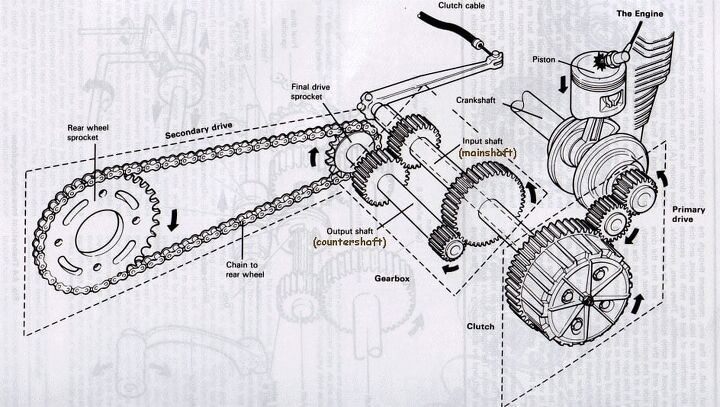
Before we can explain Power we first have to talk about Work. Work is what happens when you exert a force through a distance. Without movement there can be force, but there can not be work. For example, when you push against a heavy truck you are applying force, but, unless the truck moves, you are not doing any work. Only if the truck moves you are actually doing work, i.e. you are producing movement. Translating this to the sprocket picture above… it’s only producing work if it’s turning around.
Now we get to power. Power is the ability to do work over time. If you can do more work in less time you are more powerful. The more power you have the less time it takes to do some amount of work. For example, the more power a motorcycle has, the less time it takes that motorcycle to go from 0 to 60 mph. (This is actually not entirely true as torque and gearing also plays a big part in acceleration as we’ll see later)
Power can be expressed and calculated in several ways. In electricity we often talk about Watts, but in motor vehicles we mostly talk about horsepower. So, horsepower is a unit of power.
Intuitively we already know that torque and horsepower are related, but they are not the same. First, let’s translate above text to math:

So, Power, in the end, is the product of Torque and Speed. Torque is rotational force so we also express speed in rotational speed…RPM!
Now that we’ve covered the basic physics, let’s see how this translates to motorcycles.
To get to horsepower, we need to get our units straight first. For rotational speed we use RPM (revolutions per minute). That’s how many times the engine crank shaft rotates per minute. The engine crank shaft is the shaft that is being rotated by the engine pistons moving up and down. It’s the very first part of the drivetrain that rotates.
As torque is generally reported in one of two units, the metric Nm and the Imperial ft-lb, we have to use a slightly different formula to get to Horsepower, depending on the Torque unit:

SIDENOTE: Notice the hp(i)? This is the imperial horsepower. The imperial horse is stronger than the metric horse hp(m) 😉. To equal the strength of 100 imperial horses you need 101,43 metric horses. This is one of the tricks some manufacturers use to fluff the numbers. By reporting horsepower in hp(m), the number is higher. And of course that (i) and (m) is often left out.
Now we are getting to the core of it. So, horsepower is not the same as torque. As mathematically stated above, they are related by RPM. But, we also know that torque itself is not constant across a motorcycle rev range. Torque, as measured at the crank shaft, is dependent on the force that the pistons apply to the shaft, which, in turn, is dependent on the little explosions above the piston head. And the force of those explosions depends on several things, amongst others how big the space above the piston is and how many cilinders an engine has (engine capacity), how potent the gasoline/air mixture is, how efficient the mixture can enter and exit the chambers above the pistons, how efficient the mixture can be ignited, etc. Most of those properties are dependent on speed, i.e. depend on the speed at which the explosions need to repeat, thus, torque is also engine speed (RPM) dependent.
Typically motorcycle riders like a ‘flat’ torque curve; meaning that they would like the same amount of torque throughout the rev range of the motorcycle. Motorcycle manufacturers know this and over the years have used and invented numerous techniques to manipulate torque. Think of the rather new (but not really) BMW shiftcam technology to be found in the R1250 boxer engines. This basically makes the valve timing a variable of the rev range. And then there’s Honda’s well known VTEC technology that opens up a few more valves at about 7000 RPM. There are a bunch of other techniques, but you get the point.
These advanced techniques are not the only way torque can be manipulated. Remember the remark below the first picture… “torque can be increased or decreased by changing the radius“? The most simple way that torque is manipulated is through gearing. E.g. the chain sprockets on our motorcycle and the gears that we shift between. In the end it’s all about the torque that gets to the rear wheel.
Increasing torque comes at a cost though. Take the two chain sprockets on our motorcycle for example.

To increase the torque at the rear wheel, the rear sprocket is larger than the front sprocket. In other words, the radius of the rear sprocket is bigger. Bigger radius with same force means higher torque. This also means that, in order to rotate the rear sprocket one rotation, the front sprocket needs to rotate multiple times. In other words, to turn the front sprocket 1 rotation is less work than turning the rear sprocket 1 rotation. In other words, the front sprocket (and therefore the crank shaft) needs to turn faster (higher RPM ), needs to work harder, to achieve the same amount of rotations with higher torque.
We could chose to make the rear sprocket the same size (or smaller even) as the front sprocket. That would mean less torque at the rear wheel, but you’d also need less RPM for one rotation so you’d be able to go faster, eventually.
In the end there’s a delicate relation between torque and RPM. The higher the torque at the rear wheel, the faster you can accelerate (theoretically as at some point the wheel will start slipping of course) but you’ll reach the engine’s max RPM quicker, so your motorcycle’s top speed would be lower (leaving gears out of the discussion for simplicity). Manufacturers spend a lot of time and money on research to get this exactly right for the type of motorcycle they are developing. They have a lot of ‘dials’ to turn to get the right balance, but of course it all starts with the engine capacity and efficiency. I.e. how big and efficient the explosions above the piston heads are.
This brings us to the title of this article. How are torque and power values measured and how standardised are the numbers? Well, the general consensus is that reported torque and power values are values at the crankshaft. As seen above, the crank is the first point where rotational force is created. For cars that is measurable because the transmission sits outside of the engine in a car. However, on a motorcycle you typically can not measure at the crank shaft because the engine casing also contains the primary drive and the transmission. The first rotational force that can be measured is at the countershaft where the sprocket sits.
So, typically the first opportunity to measure horsepower of a motorcycle is at the countershaft, well after the crank. Manufacturers have their own engine dyno’s and do their own measurements and then, if not able to directly measure at the crank shaft, translate the counter shaft values to crankshaft values. Needless to say that not every manufacturer does this in the same way.

These crankshaft values are not the same as rear wheel values. Rear wheel power is measured by other kinds of dyno’s, which are often used to tune motorcycle performance, or by journalists to get real life, more comparable, values 🙂.

So, manufacturers typically report power and torque at the crankshaft. But, these are definitely not the same as the values you get at the rear wheel. There is quite some performance loss through the drive train. Typically between 15% and 20%. This depends on many factors, the sort of drive being an important one. Chain drives are usually a bit more efficient compared to shaft drives. And belt drives are more efficient than chains. And it also depends on how ‘favorable’ manufacturers report the numbers. For example BMW is known to report quite realistic.
Yes, it’s possible to measure torque at the rear wheel using a Dyno, but please keep in mind, as we discussed above, torque can be manipulated quite easily by changing radius, like gears do for example. What torque value, of what gear would you like to compare? Perhaps of all gears? That’s not really practical (or at least not common practice), so mostly torque at a ‘rear wheel’ dyno is calculated back to torque at the crank shaft (because dynos measure Power and we know the revs, torque at the crankshaft can be calculated from that easily… and that is also the value you see in the common dyno charts)
Some people will then initially think, the lower the gear, the more torque, so the more Power we will make, but this is not true. Remember the formula for calculating Power? Power is dependent on torque and RPM. So if we use a lower gear ratio, the corresponding rear wheel RPM will be reduced by the same factor as the Torque is increased, so we end up with the same power. This is a pure math.
Horsepower vs Torque. Why report both at all? Is Horsepower not enough? Well, no, not really. Because a high horsepower value can come from high torque or from high RPM. So, having both torque and horsepower values tells you how hard you need to rev an engine to get moving. A high horsepower value with a very low torque value is an indication that you’ll need to rev that engine hard. It probably also means that first gears are very short in order to go up the rev range fast to achieve a decent amount of torque for acceleration.
So, does that mean that torque is a measure for acceleration? Well, rear wheel torque YES, but crankshaft torque, not exactly, but almost. In my opinion, for the sake of simplicity, you can make that assumption when comparing motorcycle specs! Crankshaft torque is actually a measure for the potential of acceleration, because acceleration depends on crankshaft torque and how torque is changed through radius changes in the drive train, e.g. gearing. Furthermore, acceleration also depends on other factors like weight and aerodynamics of the motorcycle.
Consider this conceptual example… Let’s say we have two identical motorcycles, both have 100 horsepower, same gearing, same weight, etc. There’s only one difference. Motorcycle A has 50 Nm Torque, while motorcycle B has 100 Nm of Torque. What does this mean? Well, this means that motorcycle B can accelerate twice as fast at the same rev range. It means that motorcycle A needs to rev twice as hard compared to motorcycle B in order to achieve the same acceleration.
So, torque and horsepower are both important. Actually, for the real number geeks, you’d want to see the power and torque plotted against the rev range, because the single numbers reported by manufacturers are peak numbers that are reached at a certain RPM value.
Typically a higher torque value means that you’ll feel more ‘grunt’, more brute force, in the lower rev ranges because that engine can generate more rear wheel torque while the engine is still low in its revs, while a lower torque means that the engine needs to reach higher revs first to get to the same amount of rear wheel torque.
We still did not address how this all applies to Electric motorcycles. Obviously they don’t have explosions and pistons. Some don’t even have a crankshaft like the Verge TS mentioned at the start of this article. So, how and where is horsepower and torque measured for Electric motorcycles. Well… that’s a topic for another time. But, if you can’t wait, here’s an article from the motorcyclists about torque in eBikes. This article mentions that on a typical traditional 1000cc motorcycle, the rear wheel torque is about 10 times as high as the crankshaft torque IN FIRST GEAR. And, the BMW has 143 Nm reported crankshaft torque / 106 Nm measured crankshaft torque. That gives the BMW 1430 Nm reported torque and 1060 Nm measured torque at the rear wheel. That’s MORE than the Verge TS, again… IN FIRST GEAR. As you go up in gears (rear wheel) torque is ‘sacrificed’ for speed.
We wrote about Zero electric motorcycles before, Zero being one of the broadest known brands in the electric motorcycle space. There are many more companies though. And it seems more and more brands are popping up every month.
One of those brands is Verge Motorcycles, a Finish company. Scandinavia has been on the forefront of electric car adoption, so it’s not strange that a Scandinavian company is venturing out to the motorcycle space.
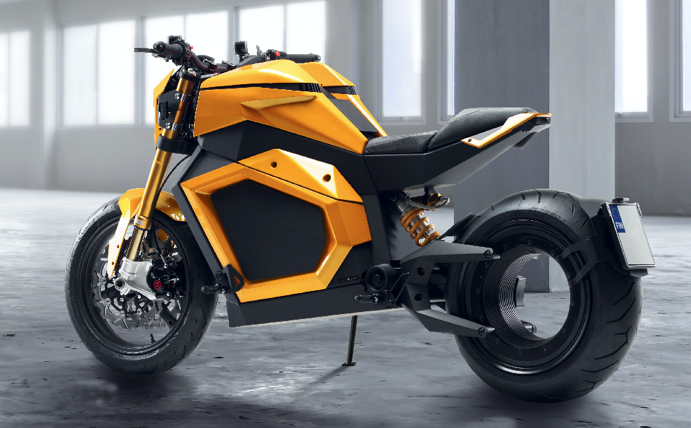
Verge’s first model, the TS, is futuristic looking with its clean look, sharp edges and hubless rim, but still unmistakably a motorcycle. I quite like it to be honest. It reminds me a bit of the Buell 1125CR which I once owned.
I’m also positively surprised by the specs. If these all turn out to be true in real life, I believe Verge might have a winner on its hands with the TS.
The most unique feature of the TS is the electric motor in the rim. This eliminates the need for a chain and is highly efficient as the electric power is transmitted to the back wheel directly, without need for any other moving parts. On top of that it looks nice as well! Just one question though… where does the air-valve go?
The TS can be pre-ordered now. Verge is following a similar approach to Tesla with its Cybertruck. You can pre-order the TS today, with a deposit of 2000 EUR. Total price of the TS is bit under 25.000 EUR. This is not cheap! For comparison, the recently released Zero SR/S which we wrote about earlier, will set you back around 15.000 EUR. That’s 10k less!!! However, the SR/S has a bit shorter range, longer charge durations, a lot less torque and looks more traditional.
Which one would you get? Me personally, living in Mexico, I’m still waiting for the range to double or more, but I can imagine if you live in Scandinavia, where distances are smaller and charging infrastructure is awesome, the TS is a good alternative to traditional motorcycles!

As we’re all locked down and social distancing, bike manufacturers have turned to virtual unveilings. In our newsletter of April 11th we wrote about BMW unveiling their R18 Cruiser. This time it’s Indian, with their 1200 FTR Carbon!
This is one beautiful machine if you ask me. With its carbon front fender, headlight cowl, passenger seat cowl and fuel tank airbox cover, it not only looks awesome…it also loses some pounds. The stainless steel Akrapovic exhaust, with its mat black titanium mufflers doesn’t look too shabby on it either 🙂
Technology wise it’s decently equipped with all the safety and luxury feature you might expect from a bike in this class. Cruise Control, ABS, Traction Control, LED lights, Lean Angle Sensitive Stability Control, Wheelie mitigation control, LED Touch Screen dash with ability to connect your mobile phone (no CarPlay or Android Auto though).
Engine wise it’s pretty much the same as the rest of the 2020 FTR family. The 120 Nm torque and 93Kw’s give it more than enough punch and power!
All in all a very nice addition to the FTR family. Here’s the official unveiling video:

Some people really LOVE cleaning their motorcycle. I’m not one of them. Never have and probably never will. Having said that I do understand why people like it. Nothing quite like spending time with your ‘love’ and making her shine like new again.
So, WHEN I clean my bike I try to do it well. And lately, well, let’s just say, I had less opportunity riding my motorcycle, leaving more time to do do other things, like, cleaning it, for example.
So, being the nerd that I am, I decided to do some research on how to best clean your motorcycle. Came across a lot of articles and videos. Conclusion? There is no one true recognised best way. Surprise surprise 🙂. Overall though, these are more or less the general steps:
* Any one of these products will have a different purpose than the ones used before 🙂
Every article author / video maker had their own favourite products and cleaning materials. No specific products sticking out though. Material wise, a common sponge to agitate / rub in the products, and some old towels and microfibers for drying did the job for most of them.
Now, I’ve yet to give this a try (ordered some products online) and I’ll let you know how it goes. If you don’t want to wait for that, have a look at this video from TheMissendenFlyer: