

BImproving riding skills | yesterday’s MotoGP race | ‘Long Way Up’ behind Apple’s paywall | 40 years BMW GS | riding against PTSD
Category Archives: General
“My medical prescription is 800-plus pounds of American-made metal and chrome”

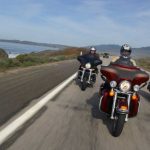
Many of us know a person struggling from the effects of Post-Traumatic Stress Disorder (PTSD). It is estimated that 8% of Americans (24.4 million people) has PTSD. This is equal to the entire population of Texas. The long-term effects can be devastating to both the individual and family as can be seen in movies like the Hurt Locker (2008) and The Deer Hunter (1978), to name a few. I briefly mentioned PTSD here.

A while ago I read about the Motorcycle Relief Project (MRP) which was founded by Tom Larson. Like many Moto Intel Report readers know, Tom became aware of how therapeutic it is to ride a motorcycle when he needed to relax and blow off some steam. He couldn’t help but think that taking veterans with PTSD and other injuries on motorcycle adventure trips could be a great way to help them to let go, learn some tools for managing stress, and connect with other veterans with whom they may have something in common. The result is Motorcycle Relief Project.

Brian Steuber a former U.S. Army staff sergeant says “My medical prescription is 800-plus pounds of American-made metal and chrome. No drug can compare; no feeling is better. That’s why I ride.” This is a common theme among vets who ride and many would like to see more vets on motorcycles. PTSD and stress in general are not unique to veterans and can affect anyone. That means riding can be a prescription for everyone. A ride is a form of relaxation – a way to remove yourself from everyday mundane life, crowded roads, and hectic and/or stressful situations.
Cycleworld makes another comparison:
“A strong argument can be made that a member of the United States military and a roadracing champion are similar. Both accept high risk, both must be fit, benefit from practice and training, work with teams, are supported by technical machinery. Both must be exact in high-pressure situations, and both suffer from mistakes.”

It just happens to be a perfect fit and many people benefit, not only veterans. Married people use riding to get rid of frustrations. Cycleworld’s Mark Thompson states the following:
“I had long understood the mood enhancing benefits of motorcycle touring, the mindful contemplation produced by days of cruising on roads like the Blueridge Parkway, but was unaware of the therapeutic benefits of track riding. I quickly discovered the effects of being hyper focused.”

With so many people suffering from PTSD and not everybody having the opportunity to let it all go at the racetrack by themselves on a local track, we knew a commercial party would come up with something and Motorcycle products retailer J&P Cycles did exactly that. It is enabling customers to invest in Wind Therapy, a treatment for post-traumatic stress disorder (PTSD) offered through 22Kill, a non-profit dedicated to traditional and non-traditional support for U.S. Military veterans.

Riding has always been a part of Stephanie Cutts’ life, for better or worse. Her husband, Frank, died in a motorcycle accident. But the 35-year-old Navy veteran has continued riding, both to honor his memory and because of the relationships she has developed in the motorcycle world. Cutts describes the motorcycle community is a vibrant, supportive group that brings together anyone who loves bikes as much as she does. It has been especially hospitable to veterans seeking healthy outlets to combat PTSD or other mental-health symptoms related to their time in the military.
“When you’re riding, there’s so much going on that your body seizes on that adrenaline,” he said. “It puts you in a place where you’re around like-minded individuals … For the most part, everybody that I’ve met is extremely friendly and wants to be involved and wants to get to know you. It’s a great community full of nice, genuine people.” Stephanie Cutts, a Navy veteran from Greenville, S.C
Of course there is no real cure to PTSD and we are not claiming that riding motorcycles is a cure. But it does help to get your mind of things and it is a helluva lot of fun and when you are having fun, everything is put in perspective. Go get some training with a licensed motorcycle instructor and enjoy the ride.
40 years BMW GS
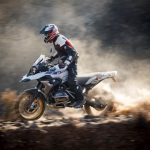
The hugely popular BMW GS (Gelände/Strasse) series has just turned 40 years old. Having created one of the longest running lines of motorcycles, this multipurpose bike has been an absolute hit in the market and continues to be the backbone of the BMW Motorrad brand.
Back in 1980, BMW launched the R80 G/S, a motorcycle that combined the best of both worlds for the very first time. The bike had great offroad capabilities but didn’t compromise on comfort while driving it around the city or highway.
Big upgrades to the series came in 1993 when BMW launched the 1100GS with the four valve boxer engine and a new type of front suspension dubbed the Telelever.
The 1100/1200 and 1250GS with their unique boxer engine and crankshaft design are perhaps the most iconic models of the series, and despite their high starting price continue to be the standard in the segment.

Other popular models include the F650GS and F800GS which were equipped with thumper engines (G650GS) or the high-torque parallel-twin. These models quickly became highly popular among riders that were looking for a slightly lighter and slimmer design.
In 2018, BMW also started to offer entry-level bikes with the G310 GS, which some (unrighteously) claim is not a ‘real’ GS.
40 years down the road, the GS remains an eye-catcher, and BMW has created yet another great GS with the new 2020 1250GS, a motorcycle that Guido has set its sights on.
As motorcycle news’ title says: life begins at 40. Something Guido can confirm for sure 😉
Learn how to improve your riding skills
In the past I’ve written a few times on ways to learn and improve your riding skills. I’ve written about finding your practice route, about high speed offroad cornering, and a YouTube channel to help you improve your skills.
This time I want to point your attention to a motorcycle skills series on cycleworld.com. This will be a series of articles, written by Nick Ienatch of ChampSchool riding school. Every week Nick will give us a drill to practice in the upcoming week during our rides. The first week was about Motorcycle Steering And Hand Pressure. Since then a few more articles were published as well, and new ones will follow weekly.

I encourage you to read through it and practice along with Nick! I strongly believe that the most important thing that can help you from being injured (or worse) while on the road is training and practice. Of course protective gear and well maintained equipment are also important, and you can’t control everything and everyone on the road, but knowing how to anticipate and handle hairy situations can be a life saver! And give you more confidence and fun on your rides all together!
Riding helps US army veteran with PTSD


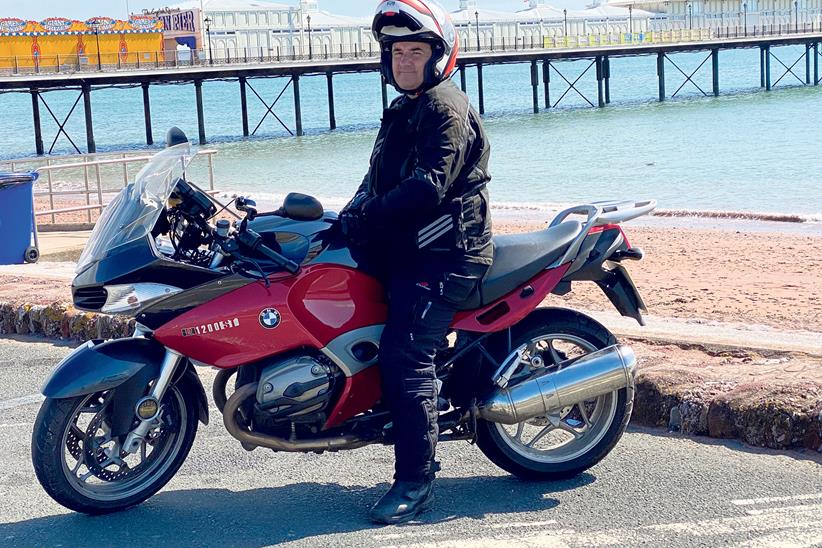
People do it to clear their mind, or sometimes to avoid personal disasters. Going for a ride has helped people deal with PTSD and other mental disorders. US army veteran Andy Brown talks about the exhilaration and how riding the bike well helps to deal with anxiety. His BMW R1200ST forced him to focus on the here and now thus giving him the tools to practice mindfulness. Read all about how this army veteran used riding to deal with his PTSD.
Moto Intel Report – July 7, 2020
Best motorcycles under $4000 | £14 million to pay by Norton’s former owner | BMW working on radar guided cruise control | Should you get an aftermarket TPMS? | Unique view on beginner motorcycles
Best bike for under $4000
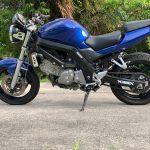
What to do if you have 4000 bucks to spend on a bike? This means you either buy a cheap new bike or you go for more quality but that means you have to get somebody else’s used bike. Bikebandit thoroughly investigated this and they came with some interesting findings.

It will probably not surprise anyone that this top 10 is compiled of mostly Japanese brands. My personal favorite is the Suzuki SV650 which was my loyal companion on so many trips. The unkillable Kawasaki KLR 650 is also a really good option which we have discussed here in the Moto Intel Report.
Harley Davidson is an old time favorite, when touring a Harley in the USA you really understand why Americans love this brand so much. People waving on the side of the road, friendly conversations in roadside restaurants and people helping out when it breaks down. Just a totally different experience from doing the same thing on a Japanese bike!
Enjoy reading Bandit’s recommendations!

Tire Pressure Management System (TPMS) Comparison Test and Review – a waste of money?
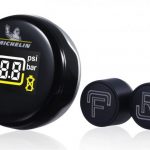
Imagine you are pass bagging in California and you feel something is off with your tire pressure. What do you do? Check your tire pressure right?
Last year we were talking about motorcycle tire pressure. As you probably know, tire pressure is a lot more important for a motorcycle than for a car. Since you only have two tires on a motorcycle, it’s a crucial safety aspect to keep them at the right pressure. Tire pressure influences grip, ride comfort, tire wear and fuel economy.
While we were discussing this we started wondering why not more bikes come with a Tire Pressure Management System (TPMS). In fact, it’s more likely nowadays that a motorcycle has cruise control than a TPMS. We found that strange since tire pressure is such a prominent safety aspect.
TPMS Comparison test and review
To find out why TPMS’s are not a basic feature nowadays, we decided to do an experiment. We would all buy an aftermarket TPMS and use it for a few months. To keep it objective we would pay for them with our own money.
Before we get into what we all bought, let’s first discuss the ‘promise’ of a TPMS system. In other words, the expectation we had from these devices.
The TPMS Promise
Without TPMS you have to measure your tire pressure manually using a tire pressure gauge. These come in a few basic forms:

Using one of these gauges, you first have to unscrew the cap of your tire valve, put one of these devices on the valve, check the pressure, then screw the cap back on. And repeat this for the other tire. Ideally, from safety perspective, you’d have one of these gauges with you all the time, and do this before every ride, with cold tires.
Another way to measure pressure without TPMS is to go to a gas station. BUT, tires heat up quite fast. A ‘spirited’ 5 minute stretch will already warm up your tires quite a lot. So, in most cases, before you reach the gas station, your tires will be too warm to get a good measurement to compare with recommended tire pressures from your motorcycle manual (which are always cold tire pressures). And don’t be mistaken, the difference in pressure between a cold and warm tire can vary quite a bit. In my experience the pressure in a warm tire can be as much as 20% to 30% higher compared to a cold tire. And I’m sure even higher values are possible.
All in all, quite an ordeal to just see your tire pressure. A TPMS would bring all this work down to almost nothing. Simply turn on your motorcycle, take a quick glance at the TPMS display and if TP is a bit too low just pass by the closest gas station to add some air. Easy peasy, right? Unfortunately quite the opposite is the case.
TPMS’s reviewed
OK, with this in mind, we all thought it was kind of a no brainer to install an aftermarket TPMS… and so… we started browsing. Basically there are two kinds of aftermarket TPMS systems. The ones where the pressure sensor is built into a bit larger than normal valve cap, or the more integrated ones where the sensor has to be installed in the tire rim. As we wanted to be able to install theses systems ourselves without the need of a mechanic, we knew we’d go for the valve cap ones.
Quite fast we discarded the aftermarket TPMS’s that worked on bluetooth (using bluetooth to send signal from valve cap to your phone and then have an app to see pressure). The reviews on those were not very good, with a lot of complaints around connectivity issues. Also, we thought it would be better to have a dedicated little display mounted on the handlebars, to see pressure even without phone.
Tom’s TPMS – NEWekey Motorcycle TPMS
Tom got the NEWekey Motorcycle TPMS at Amazon. A relatively cheap (around 50 USD) but rugged aftermarket TPMS system. The display shows tire pressure of both tires and can also display tire temperature of both tires.

Guido’s TPMS – SYKIK Rider SRTP300
Guido got the SYKIK Rider. Also through Amazon, also around 50 USD, with similar functionality than Tom’s NEWekey TPMS.

In fact, Tom and Guido’s TPMS are so similar in functionality and test results that we have a very strong feeling that these are actually built from the same electronic components, just in a different ‘package’. It wouldn’t surprise us if more of the TPMS’s on Amazon in this price range are based on the same components/sensors and thus will have the same ‘accuracy’ and disadvantages.
Jasper’s TPMS – Michelin / Fit2Go TPMS
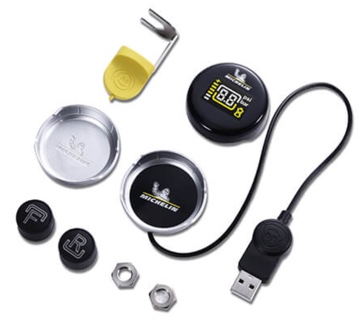
Needless to say I ordered a more premium TPMS. The Fit2Go / Michelin TPMS. I figured with that premium brand (Michelin) and higher price (more than double) it would also be a higher quality product which would suit my 2018 KTM 1090 Adventure.
The experiences
OK, so now let us talk about the experiences of all three of us. First, we’ll handle Tom and Guido’s experiences. As their experiences and their findings were nearly identical, we’ll handle them as one. After that we’ll move to my experience with the Michelin TPMS.
Installation
Installation was easy enough. The NEWekey as wel as the SYKIK came with mounting brackets to install the little display on the handlebars. Also the physical installation of the valve caps was simple. You basically screw them on like a normal valve cap, however these come with a security nut that goes on the valve thread first, which you then tighten back up against the cap in order to secure it tightly.
The valve caps are bigger and heavier than the normal caps. Logical as they contain the pressure and temperature sensors, the signal transmitter and a little battery. Two remarks about these caps:
The Caps
- For the sensors to work they need to keep the pin inside the valve (the pin that’s typically pushed up automatically by the pressure, closing the valve) pushed down somewhat, basically keeping the valve open all the time. Otherwise, how can the sensors in the cap measure pressure, right? So the valve seal with its pin doesn’t function 100% with these caps. Instead these caps close the valves by being screwed on tightly, sealing at the rim of the valve. At least… that’s what we hope/expect. This would also explain why the security nuts are there. We have to wonder though: these caps, if not screwed on tight enough, could they actually CAUSE air leakage?
- Secondly, because these caps weigh substantially more than a normal cap, we wondered whether it would be advised to rebalance the wheels to compensate for this. We did not do this, and didn’t really notice the difference while riding. Just something to keep in mind though. We are not sure a small weight difference like that calls for wheel rebalancing.

The ‘digital’ installation took a bit longer. You’ll need to tell the display which valve cap is connected to the front tire and which one to the rear tire. Easy enough, but the little manual of both the NEWekey and the SYKIK contained only very short and very bad English translated instructions. In the end, Tom and Guido got it working though. All in all the installation took less than an hour.
My Michelin TPMS looked good and at twice the price I expected European quality. But where I normally like everything French this was an utter disaster. Installation was easy though, I had to find a open space where I could paste (!) the magnetic holder, ‘click’ the screen on, screw the sensors on and ready to roll.
Accuracy
Accuracy is well… simply BAD. To test the accuracy, Guido compared the pressure indicated by his TPMS with two manual gauges. The two manually gauges both indicated a pressure of about 4 to 5 PSI MORE (0.27 to 0.35 Bar) than the TPMS. As these two gauges were consistent with each other we have to assume that the TPMS value is wrong and too low.

So, accuracy is bad, but, if at least the TPMS would ALWAYS show 4 to 5 PSI less, then that’s inconvenient, but something that could be lived with. Simply add 4 to 5 PSI in your head and you have the real pressure. OK. So far so ‘good’. Now… let’s move on to usability!
My own Michelin TPMS was ‘only’ about 2 psi off, but sometimes more and this unreliability made me dislike it. Because of the review you are reading right now I regularly checked what my actual pressure was and it was always off.
Usability
SPOILER: We all no longer have our TPMS’s installed!!! Why? Because, next to the accuracy being rubbish, usability has quite some disadvantages too. In short, it’s not delivering to the promise and expectations we had of a TPMS.
My Michelin TPMS screen only shows one tire at a time so whenever I wanted to know the pressure of the other tire, I simply had to wait. Which is a nuisance if I want to know if I just perforated the other tire or not. The KTM Adventure does not have a lot of space on its dashboard to place the monitor so I ended up having to look from a specific angle to see the screen well.
The Head Aches
- When you switch the unit on (usually when you’re ready to leave for a ride), the unit shows tire pressure values that it last received from the transmitters in the valve caps. These transmitters only seem to be active when wheel rotation (or some kind of movement or pressure change) is detected. In other words, the pressure you’d like to know (the cold tire pressure at that moment) is NOT the pressure that’s indicated on by the TPMS. In stead the TPMS displays the pressure that you ended with on your previous ride (warm tire pressure of maybe a few days ago). This, of course, is pretty useless. You’re not interested in warm tire pressure of your previous ride. What if your tier got a small leak on your previous ride causing it to deflate over days between your rides? That would not be detected before you leave. In fact, only after a few MINUTES (yes minutes, not seconds) of riding, a new reading came through on the TPMS’s. By that time the tires had already warmed up again.
What Else?
- Adding air takes more time and effort: the small wrench that you see in above picture is always required to unscrew the valve cap. So, you’ll need to carry that around all the time. Where are you going to carry that? In your jacket? Under the saddle? In any case, whenever you need to add air in your tires, you’ll need to get out that little wrench (I hope you didn’t put it under the saddle), loosen the security nuts with the little wrench, screw of the caps, add air and then all of it vice versa.
- The little display has a rechargeable battery. So, you’ll need to make sure it’s charged before your rides. The charge seems to last a long time (days), but one day, if you’re like Guido and Tom, you’re bound to find an empty battery just at the moment when you’re about to set off.
- The little display is easily taken off. What will you do when you park your bike in a public place? Will you take it off? Or just leave it on with risk of people stealing it?
The Verdict
Needless to say, this all requires more effort than just simply going back to old school gauge measuring. So, that’s what we all did. After riding around with our TPMS for about 2 months, we had enough and decided to remove it. In fact, for Guido, the ‘remove’ was initiated by the mounting bracket of the display breaking of, which was ‘the drop that spilled the cup’ for him.
I just took mine off and threw it in the fire while cursing in French. Fichue technologie! I’ll stick to French wine from now on.
What’s holding back electric motorcycles?

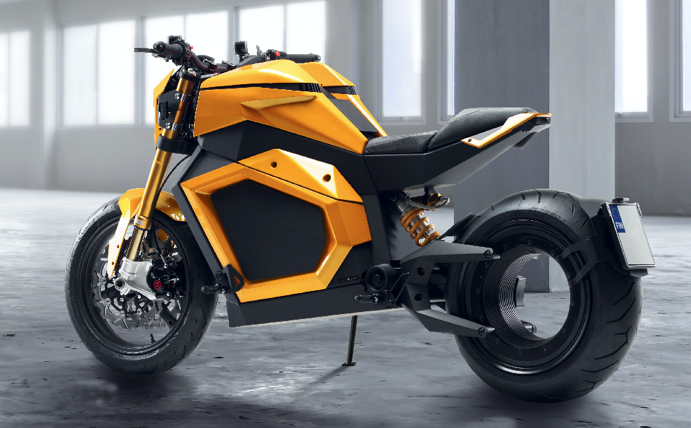
As more and more motorcycle manufacturers are adding electric models to their line-up, or are at least planning to do so, we take a look at the pros and cons of riding and owning an e-bike.
Having talked to a couple of e-bike enthusiasts, and having ridden a couple of light e-bikes myself, I can conclude that I’m not ready quite yet to buy one, but I’m all the more interested in what this new market will bring us in the next few years.
PROS
Cost of ownership
A minimum amount of moving parts means little maintenance. Electric motorcycles don’t need their oil changed every 5000 miles (8000km), and don’t need gasoline filters or air filters replaced every so often. And forget about valve adjustment too.
Depending on your annual mileage, riding style and environment, a regular motorcycle can cost you between $800 and $1500 per year in maintenance.
In terms of servicing, electric motorcycles do need brake pads, brake fluid, fork seals, bearings, chain/belt and sprockets, headlight/turn signal bulbs.
The low average cost of maintenance doesn’t mean that nothing can go wrong with electric motorcycles. Charging units and wire problems are the most frequently heard issues on today’s electric motorcycles.
Low charging costs
Typically, electric motorcycles can be a lot cheaper in terms of fuel costs. Actual costs depend on electricity cost in your country. The difference will mostly be just a few dollars less or more.
In the U.S., the average electricity price is 12 cents/kWh. The largest Zero battery is 16kWh. That means a full charge would cost about $1.75 and it will take you 98-197 miles (hwy vs city). In Germany, electricity prices are about 3 times higher at $0.35 per KwH.
Instant torque
For many of us, performance is a big thing to consider when buying a new motorcycle, and electric motorcycles can be quite rewarding to ride in terms of acceleration, thrill factor and handling.
The famous Pikes Peak international hill-climb contest, in which torque and acceleration times play a crucial role, has been dominated by electric motorcycles.
Currently, the fastest electric motorcycle for road-use on the market is the LS-218 from Lightning Motorcycles. It does 0-100 kmh (0-60 mph) in 2.2 seconds and 0-160 kmh (0-100mph) in just 5.5 seconds. According to Electrek.co, you can’t even go full throttle until after 100 mph because there is so much torque available that it will just spin and smoke the tire on the dyno.
Long battery lifetime
Many potential buyers are questioning the battery life, but the truth is that most users won’t have to replace the first battery on their electric motorcycle. Current batteries are set to last around 10 years, with around 20% power reduction during its lifetime.
New battery technology and the possible introduction of graphene-ion battery packs could significantly extend a battery’s lifespan in the future.
CONS
Range anxiety
The relatively short range of electric motorcycles is possibly the number one reason holding back new buyers. Who wants to be stuck on the side of the road on a longer trip while your friends still have 200 kilometers to go on their tank.
Increasing battery capacity sounds easy, but adding more Kwh’s in storage capacity means increasing the weight of the motorcycle significantly.
Currently, the Brutus V9 has a range of up to 270 miles/ 430 km, but this heavy cruiser weighs about 800 pounds/ 360 kgs. The more frequently seen Zero SR only lasts for 140 miles/ 225 kms, which would leave me stranded about halfway down from Mexico City to Acapulco.
Refuelling
Closely related to range anxiety is refuelling. The fact that refuelling, even with fast chargers, takes a lot longer than the few minutes it would take to fill up a gas tank, adds to the range anxiety.
Additionally, in a lot of countries around the world, the charging network still has long ways to go. Mexico is one of those countries. Sure, in big cities charging stations are available, but, on my way from Mexico City to Acapulco, charging stations are few and far between.
However, new charging technology and improved batteries are expected to hit the market within the next five years, and electric motorcycles aren’t expected to fully go mainstream before that happens.
Cost of acquisition
Together with the relatively short range, and charging time, this could be the biggest con of electric motorcycles.
Smaller models usually start around $4000-$5000 and are often just good for city-use and or short distance riding. The mid-ranged bikes such as the 2019 Zero FXS starts at almost $9000. Full-sized motorcycles, however, are much more expensive. Most full-scale electric motorcycles start at well over $20,000, with the Energica EVA Ribelle costing around $25500, the Zero SR/S setting you back at least $22,000 and the Harley Davidson Livewire costing almost $30,000.
Shifting gears
Playing with the gears on a difficult slope or shifting down a couple of gears to sprint away is no longer possible on (most) electric motorcycles, and for many aficionados, this is bad news.
Most of us will feel like riding an electric motorcycle is like riding a scooter… albeit a much faster one.
No roaring engines
No more revving in tunnels, playing with the accelerator or noise-making on the boulevard. For some it’s a convenient feature of e-bikes, but for many petrolheads, roaring engines is an absolute must, and lets be honest, artificial engine sounds are cool in science-fiction movies, but, in real life, a sputtering Harley Davidson or a snarky Japanese sports-bike just sounds better.
Fast depreciation
Electric cars and motorcycles are being developed at breakneck speed, and advancements such as better torque, handling and better batteries are to be expected within the next couple of years.
This is great for the market as a whole, but current e-bike owners will see the resale value of their motorcycles drop faster because of these innovations as they’ll render current bikes obsolete, while lowering prices of new motorcycles.
The Only Muscle Bike Without Muscles
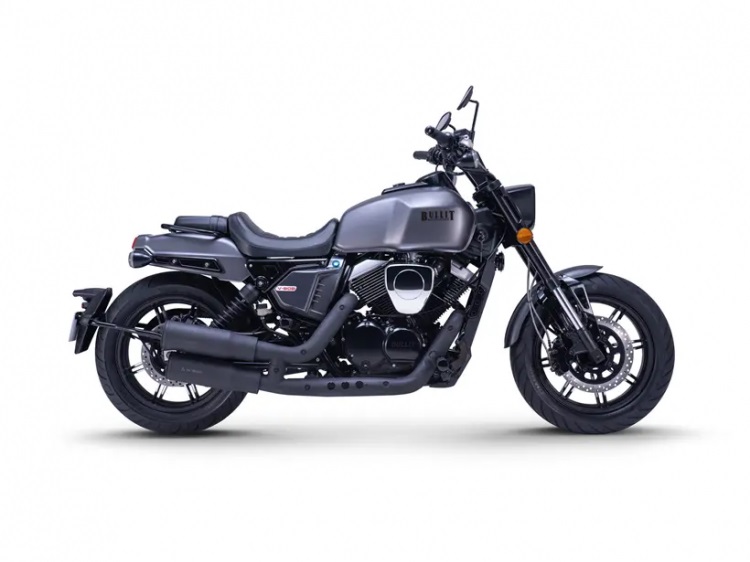
The new Bullet V-Bob 250 is described by Zac Kurylyk on rideapart.com. This Belgian motorcycle company sells Chinese produced bikes. They look relatively good and are perfect for newby riders as they don’t actually have any muscle.

Jordan Gibbons from motorcyclenews.com goes a little deeper into the specs. Don’t get too excited because this 179 kg air cooled bike carries a 250 cc engine producing only 17 hp. Probably the most surprising aspect is its belt drive 😊 Check out both articles for more information.