Imagine you are pass bagging in California and you feel something is off with your tire pressure. What do you do? Check your tire pressure right?
Last year we were talking about motorcycle tire pressure. As you probably know, tire pressure is a lot more important for a motorcycle than for a car. Since you only have two tires on a motorcycle, it’s a crucial safety aspect to keep them at the right pressure. Tire pressure influences grip, ride comfort, tire wear and fuel economy.
While we were discussing this we started wondering why not more bikes come with a Tire Pressure Management System (TPMS). In fact, it’s more likely nowadays that a motorcycle has cruise control than a TPMS. We found that strange since tire pressure is such a prominent safety aspect.
TPMS Comparison test and review
To find out why TPMS’s are not a basic feature nowadays, we decided to do an experiment. We would all buy an aftermarket TPMS and use it for a few months. To keep it objective we would pay for them with our own money.
Before we get into what we all bought, let’s first discuss the ‘promise’ of a TPMS system. In other words, the expectation we had from these devices.
The TPMS Promise
Without TPMS you have to measure your tire pressure manually using a tire pressure gauge. These come in a few basic forms:

Using one of these gauges, you first have to unscrew the cap of your tire valve, put one of these devices on the valve, check the pressure, then screw the cap back on. And repeat this for the other tire. Ideally, from safety perspective, you’d have one of these gauges with you all the time, and do this before every ride, with cold tires.
Another way to measure pressure without TPMS is to go to a gas station. BUT, tires heat up quite fast. A ‘spirited’ 5 minute stretch will already warm up your tires quite a lot. So, in most cases, before you reach the gas station, your tires will be too warm to get a good measurement to compare with recommended tire pressures from your motorcycle manual (which are always cold tire pressures). And don’t be mistaken, the difference in pressure between a cold and warm tire can vary quite a bit. In my experience the pressure in a warm tire can be as much as 20% to 30% higher compared to a cold tire. And I’m sure even higher values are possible.
All in all, quite an ordeal to just see your tire pressure. A TPMS would bring all this work down to almost nothing. Simply turn on your motorcycle, take a quick glance at the TPMS display and if TP is a bit too low just pass by the closest gas station to add some air. Easy peasy, right? Unfortunately quite the opposite is the case.
TPMS’s reviewed
OK, with this in mind, we all thought it was kind of a no brainer to install an aftermarket TPMS… and so… we started browsing. Basically there are two kinds of aftermarket TPMS systems. The ones where the pressure sensor is built into a bit larger than normal valve cap, or the more integrated ones where the sensor has to be installed in the tire rim. As we wanted to be able to install theses systems ourselves without the need of a mechanic, we knew we’d go for the valve cap ones.
Quite fast we discarded the aftermarket TPMS’s that worked on bluetooth (using bluetooth to send signal from valve cap to your phone and then have an app to see pressure). The reviews on those were not very good, with a lot of complaints around connectivity issues. Also, we thought it would be better to have a dedicated little display mounted on the handlebars, to see pressure even without phone.
Tom’s TPMS – NEWekey Motorcycle TPMS
Tom got the NEWekey Motorcycle TPMS at Amazon. A relatively cheap (around 50 USD) but rugged aftermarket TPMS system. The display shows tire pressure of both tires and can also display tire temperature of both tires.

Guido’s TPMS – SYKIK Rider SRTP300
Guido got the SYKIK Rider. Also through Amazon, also around 50 USD, with similar functionality than Tom’s NEWekey TPMS.

In fact, Tom and Guido’s TPMS are so similar in functionality and test results that we have a very strong feeling that these are actually built from the same electronic components, just in a different ‘package’. It wouldn’t surprise us if more of the TPMS’s on Amazon in this price range are based on the same components/sensors and thus will have the same ‘accuracy’ and disadvantages.
Jasper’s TPMS – Michelin / Fit2Go TPMS
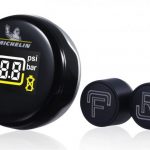
Needless to say I ordered a more premium TPMS. The Fit2Go / Michelin TPMS. I figured with that premium brand (Michelin) and higher price (more than double) it would also be a higher quality product which would suit my 2018 KTM 1090 Adventure.
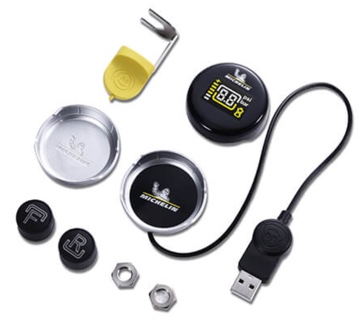
The experiences
OK, so now let us talk about the experiences of all three of us. First, we’ll handle Tom and Guido’s experiences. As their experiences and their findings were nearly identical, we’ll handle them as one. After that we’ll move to my experience with the Michelin TPMS.
Installation
Installation was easy enough. The NEWekey as wel as the SYKIK came with mounting brackets to install the little display on the handlebars. Also the physical installation of the valve caps was simple. You basically screw them on like a normal valve cap, however these come with a security nut that goes on the valve thread first, which you then tighten back up against the cap in order to secure it tightly.
The valve caps are bigger and heavier than the normal caps. Logical as they contain the pressure and temperature sensors, the signal transmitter and a little battery. Two remarks about these caps:
The Caps
- For the sensors to work they need to keep the pin inside the valve (the pin that’s typically pushed up automatically by the pressure, closing the valve) pushed down somewhat, basically keeping the valve open all the time. Otherwise, how can the sensors in the cap measure pressure, right? So the valve seal with its pin doesn’t function 100% with these caps. Instead these caps close the valves by being screwed on tightly, sealing at the rim of the valve. At least… that’s what we hope/expect. This would also explain why the security nuts are there. We have to wonder though: these caps, if not screwed on tight enough, could they actually CAUSE air leakage?
- Secondly, because these caps weigh substantially more than a normal cap, we wondered whether it would be advised to rebalance the wheels to compensate for this. We did not do this, and didn’t really notice the difference while riding. Just something to keep in mind though. We are not sure a small weight difference like that calls for wheel rebalancing.

The ‘digital’ installation took a bit longer. You’ll need to tell the display which valve cap is connected to the front tire and which one to the rear tire. Easy enough, but the little manual of both the NEWekey and the SYKIK contained only very short and very bad English translated instructions. In the end, Tom and Guido got it working though. All in all the installation took less than an hour.
My Michelin TPMS looked good and at twice the price I expected European quality. But where I normally like everything French this was an utter disaster. Installation was easy though, I had to find a open space where I could paste (!) the magnetic holder, ‘click’ the screen on, screw the sensors on and ready to roll.
Accuracy
Accuracy is well… simply BAD. To test the accuracy, Guido compared the pressure indicated by his TPMS with two manual gauges. The two manually gauges both indicated a pressure of about 4 to 5 PSI MORE (0.27 to 0.35 Bar) than the TPMS. As these two gauges were consistent with each other we have to assume that the TPMS value is wrong and too low.

So, accuracy is bad, but, if at least the TPMS would ALWAYS show 4 to 5 PSI less, then that’s inconvenient, but something that could be lived with. Simply add 4 to 5 PSI in your head and you have the real pressure. OK. So far so ‘good’. Now… let’s move on to usability!
My own Michelin TPMS was ‘only’ about 2 psi off, but sometimes more and this unreliability made me dislike it. Because of the review you are reading right now I regularly checked what my actual pressure was and it was always off.
Usability
SPOILER: We all no longer have our TPMS’s installed!!! Why? Because, next to the accuracy being rubbish, usability has quite some disadvantages too. In short, it’s not delivering to the promise and expectations we had of a TPMS.
My Michelin TPMS screen only shows one tire at a time so whenever I wanted to know the pressure of the other tire, I simply had to wait. Which is a nuisance if I want to know if I just perforated the other tire or not. The KTM Adventure does not have a lot of space on its dashboard to place the monitor so I ended up having to look from a specific angle to see the screen well.
The Head Aches
- When you switch the unit on (usually when you’re ready to leave for a ride), the unit shows tire pressure values that it last received from the transmitters in the valve caps. These transmitters only seem to be active when wheel rotation (or some kind of movement or pressure change) is detected. In other words, the pressure you’d like to know (the cold tire pressure at that moment) is NOT the pressure that’s indicated on by the TPMS. In stead the TPMS displays the pressure that you ended with on your previous ride (warm tire pressure of maybe a few days ago). This, of course, is pretty useless. You’re not interested in warm tire pressure of your previous ride. What if your tier got a small leak on your previous ride causing it to deflate over days between your rides? That would not be detected before you leave. In fact, only after a few MINUTES (yes minutes, not seconds) of riding, a new reading came through on the TPMS’s. By that time the tires had already warmed up again.
What Else?
- Adding air takes more time and effort: the small wrench that you see in above picture is always required to unscrew the valve cap. So, you’ll need to carry that around all the time. Where are you going to carry that? In your jacket? Under the saddle? In any case, whenever you need to add air in your tires, you’ll need to get out that little wrench (I hope you didn’t put it under the saddle), loosen the security nuts with the little wrench, screw of the caps, add air and then all of it vice versa.
- The little display has a rechargeable battery. So, you’ll need to make sure it’s charged before your rides. The charge seems to last a long time (days), but one day, if you’re like Guido and Tom, you’re bound to find an empty battery just at the moment when you’re about to set off.
- The little display is easily taken off. What will you do when you park your bike in a public place? Will you take it off? Or just leave it on with risk of people stealing it?
The Verdict
Needless to say, this all requires more effort than just simply going back to old school gauge measuring. So, that’s what we all did. After riding around with our TPMS for about 2 months, we had enough and decided to remove it. In fact, for Guido, the ‘remove’ was initiated by the mounting bracket of the display breaking of, which was ‘the drop that spilled the cup’ for him.
I just took mine off and threw it in the fire while cursing in French. Fichue technologie! I’ll stick to French wine from now on.